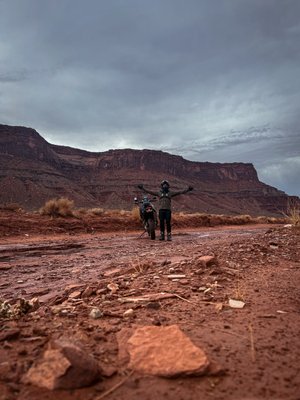
Preparing for any motorcycle adventure
Ask anyone in the military their favorite thing about their service, and they will likely never mention mission planning. The fundamental process of organizing even a simple mission can be a grueling administrative task. However, there are some good learning points in this process that can be applied to normal life.
First of all, acronyms are everyones favorite thing to invent (kinda sarcastic). Make enough of them and you can basically form of language. The military loves these because you can convey a lot of words, without saying a lot of words. And in this case, it can serve as a simplified way to focus planning into categories. Creating a simple baseline plan that acts as a guideline. Ensuring you’re not miles away wishing you had brought something you didn’t realize you needed. No matter how big or small.
For this I’ve created an acronym called TORK-M.
I’ll breakdown each category with further explanations and how it all works.
Terrain & weather
Objective / goal
Route
Keep me alive
Motorcycle
Terrain & weather
The first gentle step into the cold sticky mud. It’s a simple consideration that’s reflected throughout the rest of planning and preparation. What type of terrain are you going to ride, and what type of weather is expected? This can require a little research, but it’s better to be late than broken on an icy road. If you’re riding off-road this is even more detrimental. Certain terrain can become impassable with even a little rain. Creek crossings can turn into raging currents. Flash floods can literally kill you. Don’t underestimate weather changes across the terrain you’re planning to cover. Keep “terrain and weather” into consideration for the rest of your preparation.
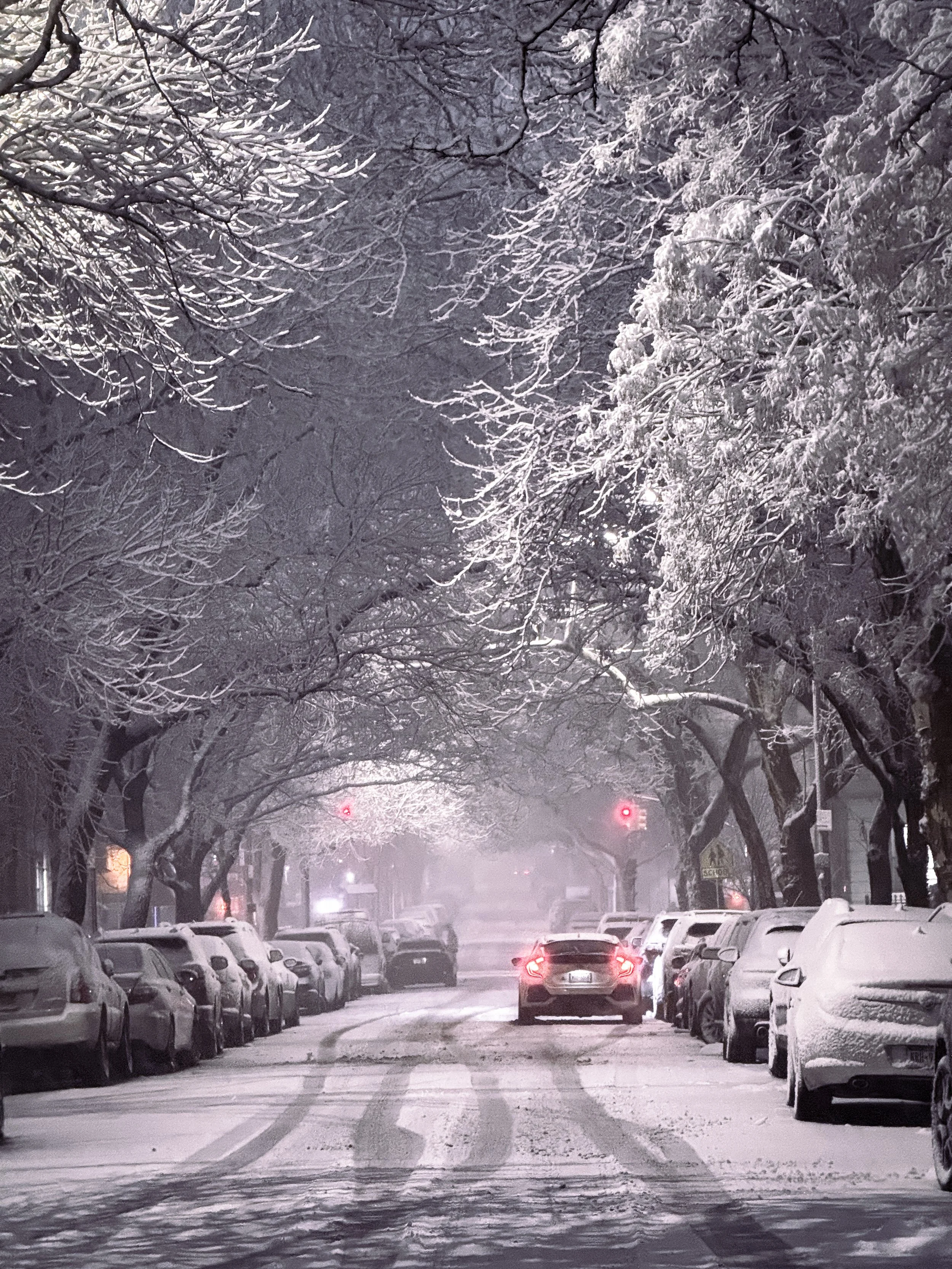
Frosty Brooklyn roads
Objective / goal
A simple objective or goal for your motorcycle adventure.
Who is going with you (if not solo)?
What are you doing?
Where are you going?
When are you going?
Why?
This simple piece is usually referred to as the “5 W’s”.
This may seem like an unnecessary piece when talking about planning. But when it comes down to it, these are basically a list of your priorities. A simple phrase to remember to keep life simple during planning.
For example:
“ I (who) am going to ride my motorcycle to Arizona from Montana (What / were). I will leave on July 5th and arrive at my destination by July 15th (When) to attend my brothers wedding (why).
You can mad lib these couple sentences to something that fits whatever you’re doing. It is important to keep it simple though. Motorcycle adventures can change in instance when something doesn’t go as planned. This is the time to reflect on what your goal of the trip is, and replan accordingly to meet that goal. Or to use as a meter to judge when to call it a bust and return home.
Route
Building a route is probably the most time intensive piece of this puzzle. But can also be the most exciting. This is also a good time to reflect on the Terrain and weather portion of planning, even if you’re not riding off-road trails.
There are a multitude of tools to help in this process. You can go old school and use a paper map of the region you’re riding. Plotting points and measuring distances manually. Or you can use whatever technology is available to you. I personally utilize Gaia GPS to build routes, and then export to Garmin Explore. Using tech can get messy and it’s always a good idea to have some type of backup device or map. Especially one that doesn’t require batteries.
I nearly lost my Garmin Zumo XT because I crashed multiple times down a rocky hill in the night. I only realized it was missing because when I looked down to find secure footing to pick up my motorcycle, a black square rock looked very out of place (my Garmin).
This post isn’t going to go into how to read a map, or use a very specific application to build a route. but I will give you some considerations to use during the route building process.
Fuel stops - This is going to be the main legs of your trip. Starting at point “A” with a full tank, riding towards point “B” that also has fuel available. The distance between A and B are going to heavily depend on the bike you ride, how you ride, and your terrain. Your fuel gauge should be used as a reminder that you need fuel, I personally do not fully rely on the gauge alone. I reset my odometer every time I top off on fuel so I have another reference when determining how far I have left. I always fill up before my safety margin, which is right around 200mi +/- 10mi. I know I can safely go 240mi with my current setup. If you’re unsure of how many miles you can get out of your bike you can always test it. Reset your trip meter on your bike, or gps tracking on your next fill up. Keep that running to get an estimation of how many miles you’re getting before you’re next fill up. There’s nothing worse than being on a beautiful ride and only stressing out about running out of fuel.
Food / Lodging - Just like planning to fuel your bike, you need to fuel your body. I’ve had plenty of times where I roll into a town to get fuel, food, and camp. Only to find everything is closed, and every single camping area within 5 miles is completely full.
On one of my most exhausting riding days I rolled into a fairly large town and decided I deserved a night at a hotel. The town was a fair size and there were about 12 hotels to choose from. Little did I know, there was both a graduation and a gold mining convention that just began. Literally every place was booked out for a week. This lead me to slamming some Mexican food and crushing more miles into the day. Which eventually turned into one of the most challenging rides i’ve been on. But we’ll save that for another day. Let’s just say that night ended with sleeping next to my bike and a woodpile behind a remote bar.
Food and lodging (or camping) are generally the end points of your trip. Whether it be multi day, or an out and back weekend trip. You eventually need to eat, and its favorable that you get rest before embarking on another portion of the trip. Take into consideration the time it may take to cover distances, what time you’ll arrive, and reserve ahead if applicable. I personally plan this portion a little loose, because I don’t mind sleeping next to my bike on the side of the road. But I’ve also wasted a lot of time hunting for somewhere to stay for the night because I did not reserve ahead. Sometimes I just get lucky. Other times I can’t fall asleep because a random spot in the woods I chose gets spooky.
Points of interest (POI) - POI’s serve two purposes. They’re often great places to take a break and have a snack. And they’re usually pretty cool places to see. Wherever life is taking you, see what’s on the way and take a break. Learn something about where you’re traveling through. Or just take some cool pictures to remember.
Lastly on the subject of route planning, is riding in groups. Don’t forget to take into account every riders ability and endurance. Plan on riding through terrain you know the entire group can accomplish, and consider everyones endurance. You’re only as fast as the slowest person in your group. And there’s nothing wrong with being that person. They’re probably having the most fun.
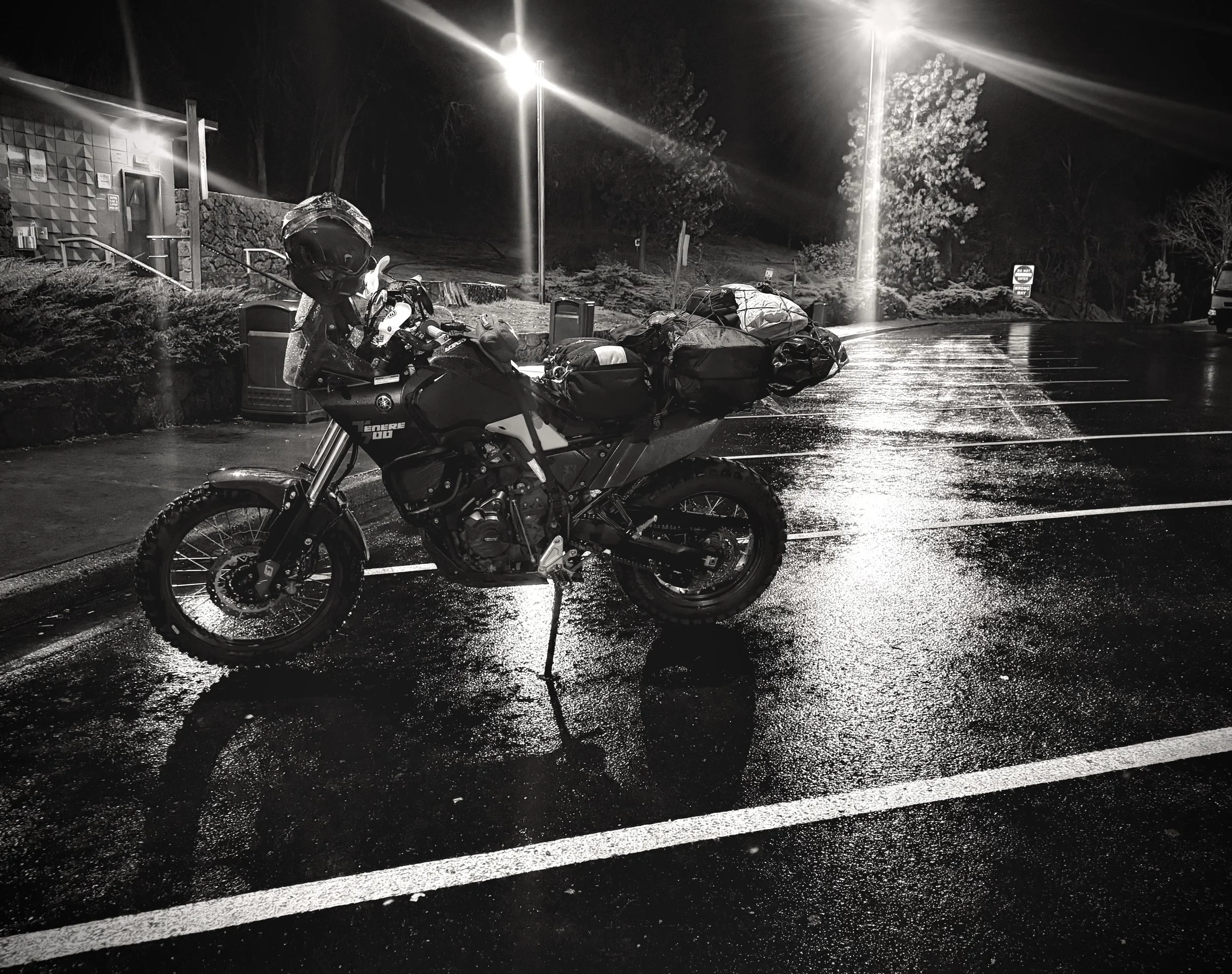
Taking a mental break after hours of rain and night riding at the WA/OR border
Keep me alive
So you’ve made it this far into planning. This is where it’s easy to get over creative. This section can also be referred to as contingency planning.
Ask yourself questions like, if i get a flat tire, do I have the tools to fix it? Or will I just call someone? If I get stuck somewhere overnight, do I have food and shelter? The temperature has a potential to reach “cold”, can I keep myself warm?
The list of “what if” questions can become endless. Don’t let this hinder you. You likely don’t need to pack a spare chain and oil. Or maybe you do because the area you’re traveling in does not have your specific needs. My recommendation is to keep it bare bones. Enough to get you through an unexpected event, but maybe not in the most efficient way possible. You can do a whole lot with a ratchet strap if you’re willing to get creative. With that being said, realistically ask yourself what you’re capable of. Or will this be a learning experience. And are you actually going to tackle cutting down that downed tree on the trail?
This is a time to ask yourself what you might need if things get weird.
Here is a list of items I will generally consider:
Tools / maintenance items
emergency food
water water water
maps
temperature mitigation (cold and/or hot clothing)
Medical aid / SOS device
A small practice I do on every ride, no matter the distance. Is keeping my Garmin InReach in my backpack. I never pack it on the bike, it always stays on me. My phone is usually attached to my bike and that would be my primary SOS device. But considering the freeing nature of not being attached to the motorcycle. The last thing I want in life is to be broken in a ditch, just off the side of the road where no one can see me, and be helpless.
Motorcycle
Last and certainly not least. Your loyal steed.
A portion that is not to be overlooked of this entire process. Ensuring the vehicle in which you plan on taking on your journey is also prepared for whatever you’re going to put it through.
You might be able to procrastinate some maintenance on shorter trips. But if you’re about to embark on a long trip, or an adventure into some rugged terrain, your bike needs to be as ready as you are.
Oil, air filters, brakes, tires, coolant, chains, sprockets, torquing bolts, battery life etc.
This is the time to focus on doing a thorough inspection of your motorcycle. Replacing and changing wear parts like bearings and brakes. Rebuilding suspension, servicing engine components, etc. And getting the right tires for the terrain you’re about to tackle.
I’ve personally rode some 4x4 trails in death valley with stock 50/50 tires on an ADV motorcycle. But would I do it again? probably not. When I know i’m going to do a lot of riding in the dirt, I’m going to throw a dirt heavy tire on my bike. I could run an aggressive enduro tire on my motorcycle, but if I also want to safely do highway speeds as well. I will make the small sacrifice of traction for road performance.
Much like alleviating the stress of running out of gas. A well prepared motorcycle will help you enjoy your adventure to the fullest.
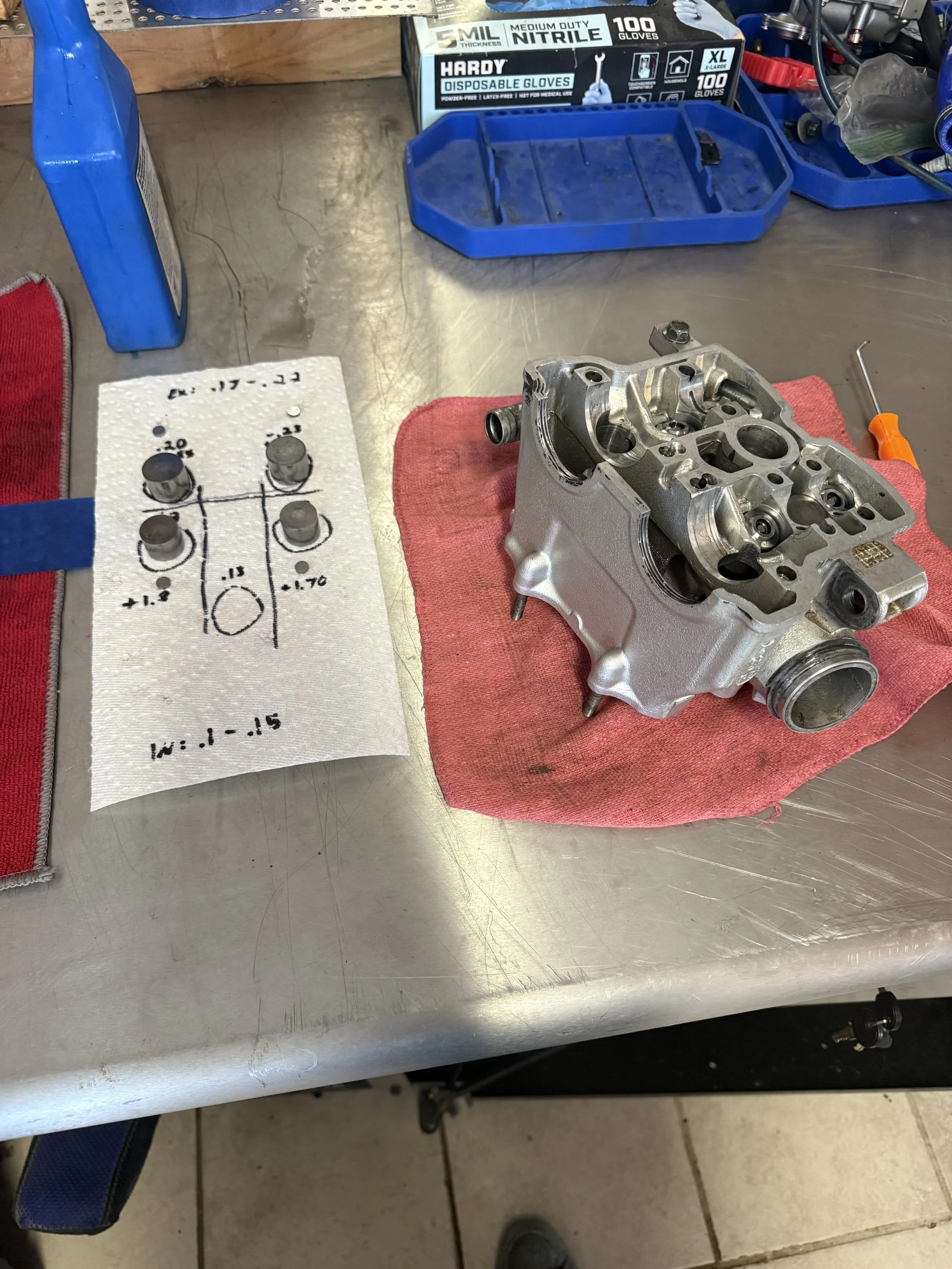
Prepping a yz250f for race day!
In the end, you can do everything right and still come up unsuccessful. Enjoy the process, enjoy the journey. Whether its a terrible time or a great success.
Have fun.